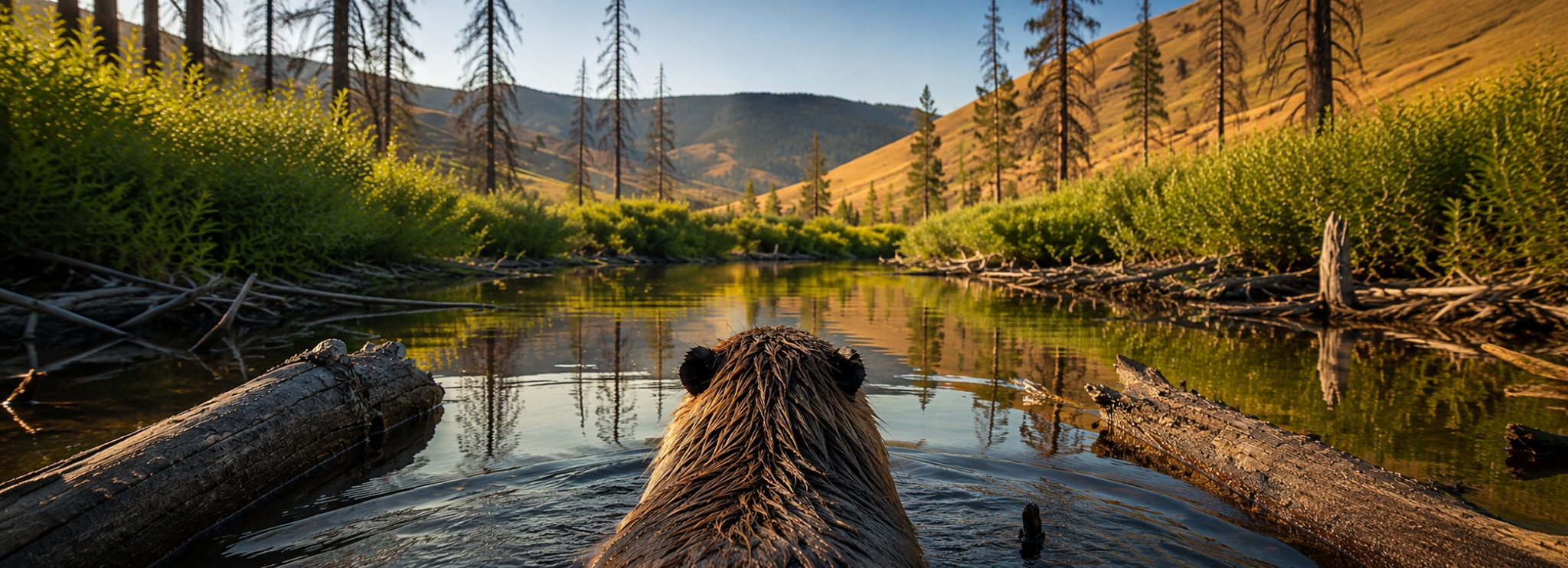
Beaver Field Notes: Seeing the Stream from the Pond
The word umwelt comes from the German biologist Jakob von Uexküll. In plain English, it means the world as an animal experiences it from the inside. Not the world as a human maps, photographs, measures, or describes it - but the world as it matters to that animal through his senses, body, needs, fears, habits, and abilities.
Consider a meadow. To a hawk, a bee, a cow, a tick, a meadowlark, and a beaver, it is not one shared world. It is many overlapping worlds. Each animal occupies the same physical place, but each one notices different signals, responds to different risks, and follows different needs.
The hawk reads motion from above. The bee reads flowers, scent, and light. The cow reads forage, shade, herd pressure, water, and fence. The tick reads warmth and body odor. The beaver reads water depth, current, woody stems, mud, scent, predators, bank shape, lodge security, and the sound of moving water.
That is umwelt.
It is not just “habitat.” Habitat is often how humans describe a place from the outside: stream gradient, valley width, vegetation, flow, soil, shade, disturbance, and forage availability. Umwelt asks a more intimate question: What does this place mean to the animal living inside it?
For beavers, that question matters. A stream reach may look promising to us because it has water, willows, or good geomorphic potential. But from the pond-view, that same reach may feel too shallow, too exposed, too flashy, too far from dependable food, or too risky for kits.
The human sees a project site. The beaver experiences a survival calculation.
The Beaver's Umwelt
A beaver likely experiences the world first and foremost as a water-centered safety system.
Humans tend to stand on the bank and look down at the creek. A beaver’s view is almost the reverse. The pond is home base. Water is cover, transportation, food access, escape route, construction medium, and family space. A foot of water depth is not just a measurement. It can mean safety from predators, easier movement of branches, hidden lodge entrances, and lower energetic cost.
From a beaver’s umwelt, the stream is likely divided into zones of safety and danger. Deep, quiet water near a lodge or bank den is high-security space. Shallow exposed crossings are riskier. A good willow patch fifty feet from water may matter. The same willow patch two hundred feet from water may barely count if reaching it requires too much exposure.
That is why “available forage” cannot mean every willow growing somewhere in the valley bottom. For a beaver, available forage is food that can be reached, cut, hauled, cached, and eaten without too much danger or energy loss.
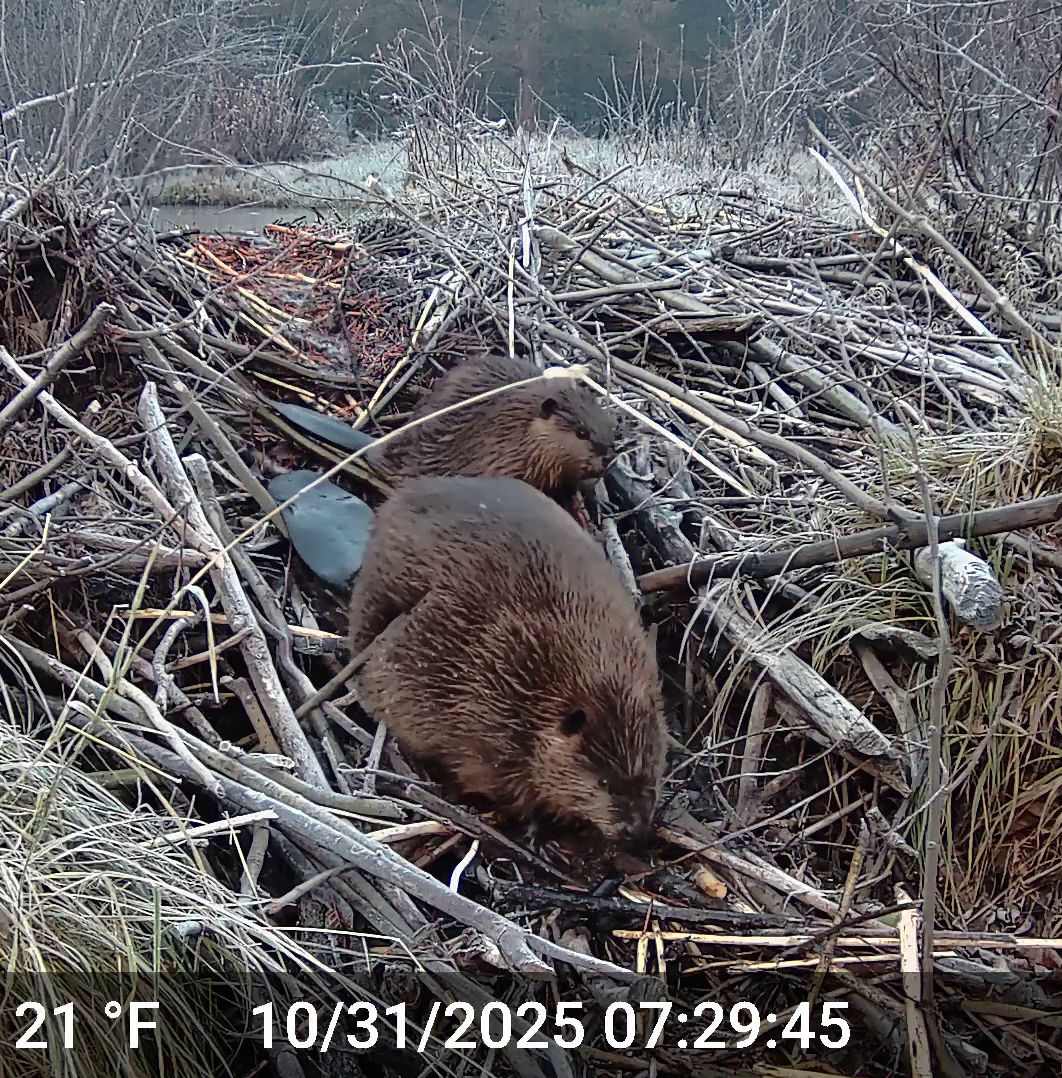
What the Beaver Is Reading
A beaver likely reads a stream through overlapping signals.
Water tells the beaver what is possible.
Depth, current, leakage, sound, and seasonal persistence all matter. The sound of running water is not just background noise. To a beaver, it can be a repair signal. Flow through a dam, breach, culvert, or weak point may call forth action. Moving water may say: work here. plug this. hold this pond together.
Riparian woodies tell the beaver whether a family can stay.
Willow, cottonwood, and aspen are not just “riparian vegetation.” They are winter calories, building material, cutting sites, shade, cover, cache material, and future regrowth. A beaver likely experiences a willow stand through stem size, distance to water, cutting effort, palatability, safety, and regrowth potential.
That is the hard part in many dryland systems. A place may have some willow and still not have enough willow. Beavers can start in thin forage, but they may not be able to persist there. They may live on the energetic edge, cycle through, knock the site back, and move on.
From the beaver’s point of view, a few scattered plants are not a pantry. They are a short-term ration.
Mud, bank shape, and substrate tell the beaver whether the place can be engineered.
A bank that looks plain to us may offer denning potential. A narrow pinch point may invite dam building. A muddy edge may be useful. Old wood and roughness may help hold structure. But a broad, shallow, incised reach may feel like too much work unless there is enough water, wood, mud, and stability to make the effort pay off.
Beavers are powerful, but they are not magical. Their world includes limits: body size, family labor, available food, repair demands, seasonal flow, drought, and predator risk. A site has to pencil out for the animal.
Scent tells the beaver who is present.
Beavers live in a social landscape. Castoreum, scent mounds, trails, fresh cuttings, food caches, old dams, lodges, bank dens, and mud work all carry information. To us, an old scent mound may be a field observation. To a beaver, it may say: occupied, contested, available, familiar, risky, or worth investigating.
The stream network is not empty space. It is a living map of families, vacancies, boundaries, and opportunities.
The Stream as a Working Mosaic
A beaver probably does not experience a stream as one continuous scenic corridor. It likely experiences it as a working mosaic of safe, useful, risky, costly, familiar, and unknown places.
To a person, a half-mile reach may be one management unit. To a beaver, that same reach may include a safe pond core, a bank den or lodge zone, near-water forage patches, exposed open ground, shallow travel bottlenecks, old dam remnants, fresh mud sources, predator approach areas, family scent boundaries, winter cache opportunities, and possible expansion sites for kits or dispersing offspring.
That is the heart of the umwelt idea:
The beaver’s world is not our map. It is a lived, bodily, sensory, energetic world.
A settled adult beaver in a home pond may experience the site through routine and responsibility. He patrols, repairs, cuts, hauls, marks, listens, smells, and responds. A small leak is not a hydrologic detail. It is a demand. A new scent is not a curiosity. It is a social event. A drying pond is not simply a “low-flow condition.” It is a threat to the lodge, the food cache, the kits, and the family’s future.
A dispersing young beaver likely experiences the stream differently. For the disperser, the stream may be a sequence of uncertainty: move, smell, listen, avoid, test, feed, rest, keep going. A site that looks restorable to us may feel like a dead end if it lacks safe water, sufficient forage, cover, or social room. A messy place with old wood, slow water, and protected willow patches may feel more promising than a clean-looking channel with pretty banks but no real cover.
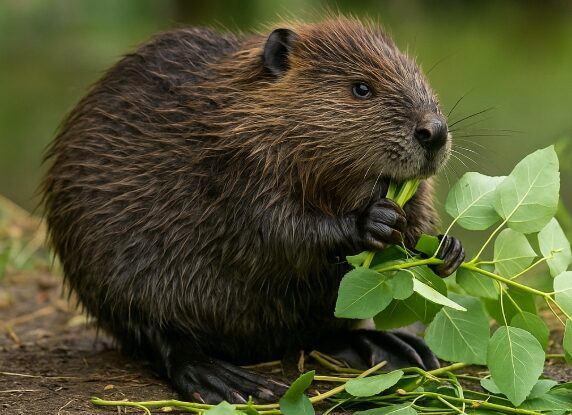
That is at the heart of umwelt: the beaver’s world is a lived, bodily, sensory, energetic world.
Living Inside the Beaver’s World
The umwelt lens asks us to slow down and remember that animals are not moving through our version of the world. They are moving through their own.
For a beaver, the world is arranged by water, scent, sound, touch, safety, forage, family, movement, and time. A willow is not just a plant. A dam is not just a structure. A pond is not just retained water. A stream is not just a channel.
A beaver’s life is full of practical questions.
- Can I stay wet and hidden?
- Can I move safely?
- Can I hear where water is escaping?
- Can I smell who else is here?
- Can I cut and haul enough food without too much exposure?
- Can this place hold together through the season?
- Can my kits survive here?
- Can my offspring move from here to the next livable place?
Those questions are not abstract. They are the daily terms of survival.
Seeing from the pond-view does not mean pretending we can fully know what a beaver experiences. We cannot. But we can become better observers. We can pay attention to the signals that likely shape the beaver’s world: the waterline, the mud, the sound of leakage, the distance to forage, the exposed crossings, the scent mounds, the den banks, the old cuttings, the protected willow patches, the worn trails, the quiet ponds, and the risky gaps.
Beavers are not simply builders of dams. They are sensing, choosing, remembering, social animals living inside a world we only partly perceive.
To a beaver, the right place is a living workspace, pantry, shelter, nursery, travel route, and inheritance for the next generation.